

Making a real difference in your community takes more than passion. Many well-intentioned leaders launch initiatives that lose steam, miss key voices, or never move past the planning stage. The gap between good intentions and lasting impact is almost always a process problem, not a people problem. This guide walks you through a research-backed sequence: assess what your community needs and already has, build genuinely inclusive leadership, design initiatives that stick, and measure results in ways that actually drive growth. Whether you work in K-12 youth development, neighborhood organizing, or broader civic engagement, these steps will sharpen your approach.
Table of Contents
- Assessing your community's needs and strengths
- Building inclusive engagement and leadership
- Designing and launching community initiatives
- Measuring, evaluating, and scaling impact
- Challenging traditional approaches: Why empowerment, not control, drives results
- Partner with YES Foundation for deeper community impact
- Frequently asked questions
Key Takeaways
| Point | Details |
|---|---|
| Start with assessment | Understanding your community’s needs and strengths is critical to successful impact. |
| Prioritize inclusion | Empowering diverse voices leads to more sustainable and trusted results. |
| Plan and measure | Purposeful action and ongoing evaluation ensure lasting positive change. |
| Value participation | Recognizing and compensating contributors fosters deep engagement. |
Assessing your community's needs and strengths
Before you launch anything, you need a clear picture of where your community stands. That means gathering real input, not just assumptions. Surveys, listening sessions, and direct observation are your three core tools. Each one captures a different layer of truth.
Surveys give you breadth. They reach people who might not show up to a meeting. Listening sessions give you depth. They surface stories, frustrations, and ideas that a checkbox form will never catch. Observation fills the gaps. Walking through a neighborhood, sitting in on a class, or attending a local event tells you things that neither surveys nor sessions will reveal.
Circle practices for community building are vital assessment tools because they create structured space for honest dialogue. In a circle format, every participant has equal standing. There is no head of the table. That equality shifts the conversation from reporting to genuine sharing, which is exactly what you need when you are trying to understand a community's real priorities.
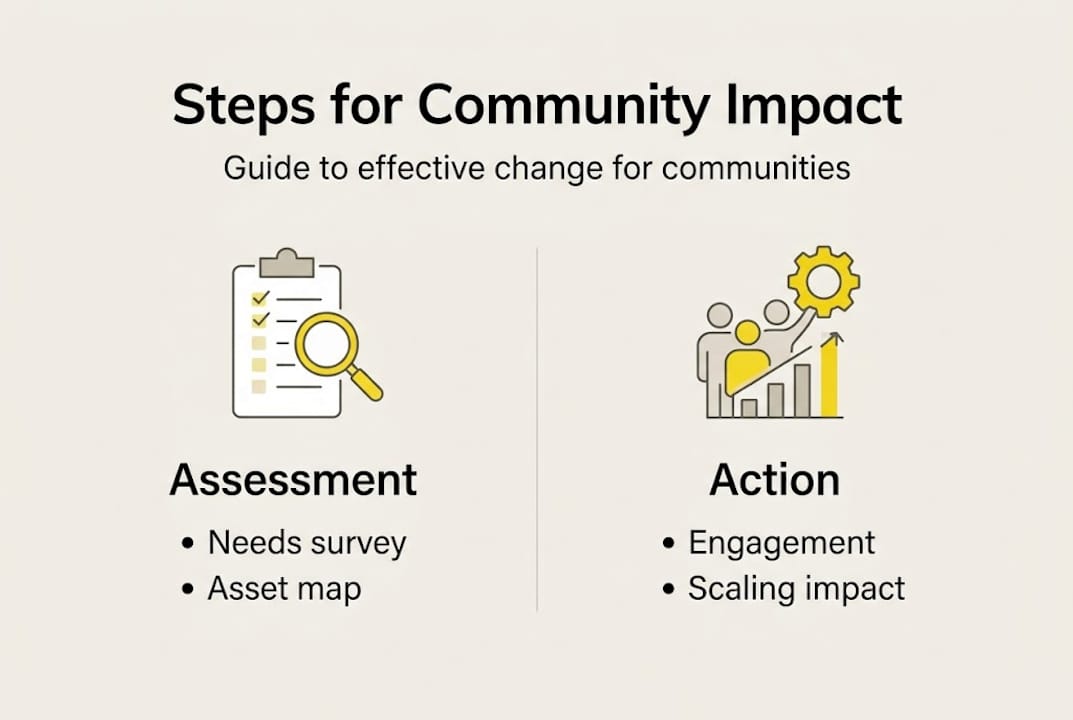
Document everything. You are building two parallel inventories: a needs list and an asset map. Needs are gaps. Assets are strengths, resources, relationships, and skills already present in the community. Most leaders focus only on needs and miss the power sitting right in front of them.
Pro Tip: Start with the simplest assessment tool that will give you useful data. A one-page survey or a 30-minute circle session beats a complex research project that never launches.
Common assessment methods at a glance:
| Method | Best for | Time required |
|---|---|---|
| Online survey | Broad input, anonymous feedback | 1 to 2 weeks |
| Listening session | Deep stories, relationship building | 2 to 3 hours per session |
| Community observation | Context, informal patterns | Ongoing |
| Focus groups | Specific topics, targeted populations | 90 minutes per group |
Here is a quick checklist to get your assessment started:
- Identify 3 to 5 key questions you need answered
- Choose at least two data collection methods
- Recruit community members to help facilitate, not just participate
- Set a clear timeline for collecting and reviewing input
- Share findings back with participants before moving forward
Sharing findings back is non-negotiable. It builds trust and confirms that you heard people correctly. Use this community building toolkit to structure your assessment process from the start.
Building inclusive engagement and leadership
Assessing your community sets a foundation, but achieving impact depends on how well you include and empower all voices. Inclusion is not a checkbox. It is a daily practice that shapes every decision you make.
Servant leadership is the right frame here. Servant leadership pillars are essential for building inclusive community engagement because they flip the traditional power structure. Instead of leading from the top, you lead from alongside. You ask what people need, remove obstacles, and amplify voices that are usually quiet.
Not all engagement looks the same. There is a spectrum, and knowing where you are on it matters.
| Engagement level | What it looks like | Community power |
|---|---|---|
| Informing | Sharing decisions already made | Low |
| Consulting | Asking for input before deciding | Moderate |
| Involving | Collaborating on options | High |
| Co-creating | Community shapes the outcome | Highest |
Co-creation is the goal. It takes longer to get there, but the buy-in and ownership it produces are irreplaceable.
CBPR empowerment strategies address power dynamics through cognitive and relational empowerment, meaning they help people both understand their own capacity and build the relationships needed to act on it. This is the foundation of sustainable engagement.
"When communities shape their own decisions, they are far more likely to sustain the results long after the initial program ends."
Here is a step-by-step approach to making leadership accessible:
- Audit your current leadership team for gaps in representation
- Create formal roles for community members, not just advisory seats
- Offer training and mentorship so new leaders can grow into responsibility
- Build in regular feedback loops so leaders at every level can adjust
- Celebrate contributions publicly to reinforce that leadership belongs to everyone
Language matters too. Hold meetings at accessible times, provide translation when needed, and offer childcare or transportation support when possible. Removing practical barriers is just as important as removing cultural ones.
Designing and launching community initiatives
With inclusive engagement and leadership established, it is time to turn ideas into impactful action. The design phase is where many initiatives stall because the jump from conversation to program feels overwhelming. It does not have to be.

Start by mapping your initiative objectives directly to what your assessment revealed. Every program goal should trace back to a documented need or a community strength you want to build on. If you cannot make that connection, the goal probably does not belong in this initiative.
Decision tools help prioritize and shape effective community initiatives by giving your team a structured way to compare options. A simple priority matrix, where you weigh impact against feasibility, can cut hours of debate down to a focused 30-minute conversation.
Follow these steps to move from idea to launch:
- Define your purpose. Write a one-sentence statement of what the initiative will change and for whom.
- Identify your stakeholders. List everyone affected, including people who might push back.
- Map your actions. Break the initiative into specific, assignable tasks with clear owners.
- Set timelines. Attach realistic deadlines to each task and build in buffer time.
- Build feedback loops. Decide in advance how you will collect input during the initiative, not just at the end.
- Plan your close. Know what success looks like and how you will communicate results.
The engagement framework steps move from defining purpose all the way through closing feedback loops, and that full arc is what separates programs that finish strong from ones that quietly fade.
Pro Tip: Run a pilot before you scale. A small test with 20 participants will teach you more than six months of planning. Pilot results give you real data, build credibility, and help you refine your approach before committing full resources.
Key questions to answer before launch:
- Who is responsible for day-to-day coordination?
- What resources do you have confirmed versus assumed?
- How will you communicate progress to the broader community?
- What is your plan if participation is lower than expected?
Measuring, evaluating, and scaling impact
Once your community initiative is underway, ongoing measurement ensures you maximize and sustain its impact. Measurement is not a bureaucratic requirement. It is how you learn what is actually working.
Track three categories of outcomes: participation, satisfaction, and results. Participation tells you who is showing up. Satisfaction tells you whether the experience is worth their time. Results tell you whether the initiative is moving the needle on the original need.
| Metric type | Example indicators | Collection method |
|---|---|---|
| Participation | Attendance, repeat engagement | Sign-in sheets, registration data |
| Satisfaction | Perceived value, likelihood to return | Short surveys, interviews |
| Outcomes | Skill gains, behavior change, goal progress | Pre and post assessments, follow-up |
Closing feedback loops and measuring equity ensure lasting results. Equity measurement means disaggregating your data. Look at outcomes by age, race, income level, and other factors to see whether the initiative is serving everyone or just the easiest-to-reach participants.
"Data without action is just documentation. The goal is to use what you learn to improve, not just to report."
Compensation benchmarks recognize and reward participant contributions, and this matters more than most leaders realize. When community members give their time, expertise, or lived experience to your initiative, compensating them fairly signals respect and encourages broader involvement from people who cannot afford to volunteer indefinitely.
When you are ready to scale, keep these principles in mind:
- Scale what the data supports, not what feels good
- Bring in new partners before you expand, not after
- Document your model clearly so others can replicate it without losing fidelity
- Invest in leadership development so growth does not depend on a single person
- Revisit your assessment process as the community evolves
Scaling is not just doing more. It is doing the right things in more places, with more people, at a higher level of quality.
Challenging traditional approaches: Why empowerment, not control, drives results
Here is what most leadership training does not tell you: the biggest threat to community impact is not lack of resources. It is the instinct to control outcomes.
Traditional, hierarchical approaches feel efficient. One person decides, others execute. But that model quietly kills the creativity, ownership, and trust that sustain community work over time. When people feel managed rather than empowered, they comply in the short term and disengage in the long term.
We have seen this pattern repeat across youth development programs, neighborhood initiatives, and civic projects. The programs that outlast their founders are almost always the ones where community members shaped the work from the beginning. They are invested because they built it.
Empowerment is not soft leadership. It is the most strategically sound approach available. It distributes risk, multiplies capacity, and builds the kind of trust that no marketing budget can buy.
Pro Tip: Facilitate rather than dictate. Your job is to create conditions where others can lead. Be open to evolving your methods as the community grows and changes.
Partner with YES Foundation for deeper community impact
If this guide gave you a clearer path forward, you do not have to walk it alone. YES Foundation exists to support exactly the kind of work you are doing: building leaders, strengthening communities, and creating programs that generate real, lasting change.
Through YES Foundation community programs, you can access training resources, leadership toolkits, and partnership opportunities designed specifically for educators, youth development professionals, and community organizers. Whether you are launching your first initiative or scaling an established program, we offer practical support grounded in the same empowerment principles this guide covers. Reach out and let us help you take your community impact to the next level.
Frequently asked questions
What are the first steps for starting a community empowerment initiative?
Begin by assessing your community's assets and needs using surveys, listening sessions, and observation, then invite broad participation in identifying priorities. Circle practices and assessment are recognized first steps for community building that create shared understanding from the start.
How do you make engagement inclusive for all community members?
Adopt servant leadership, eliminate practical barriers like meeting times and transportation, and use co-creation practices that give community members real decision-making power. Inclusive engagement hinges on accessible leadership practices that center the voices of those most affected.
What measures indicate a successful community initiative?
Look for meaningful participation rates, clear progress toward the goals identified in your assessment, and regular feedback from all stakeholders. Feedback loops and outcomes are core components of any credible success measurement framework.
Why is compensation important in community engagement?
Compensation shows respect for participants' time and expertise, and it encourages broader, more equitable involvement from people who cannot afford to give their time for free. Compensation benchmarks support equity by ensuring that engagement does not favor only those with financial flexibility.